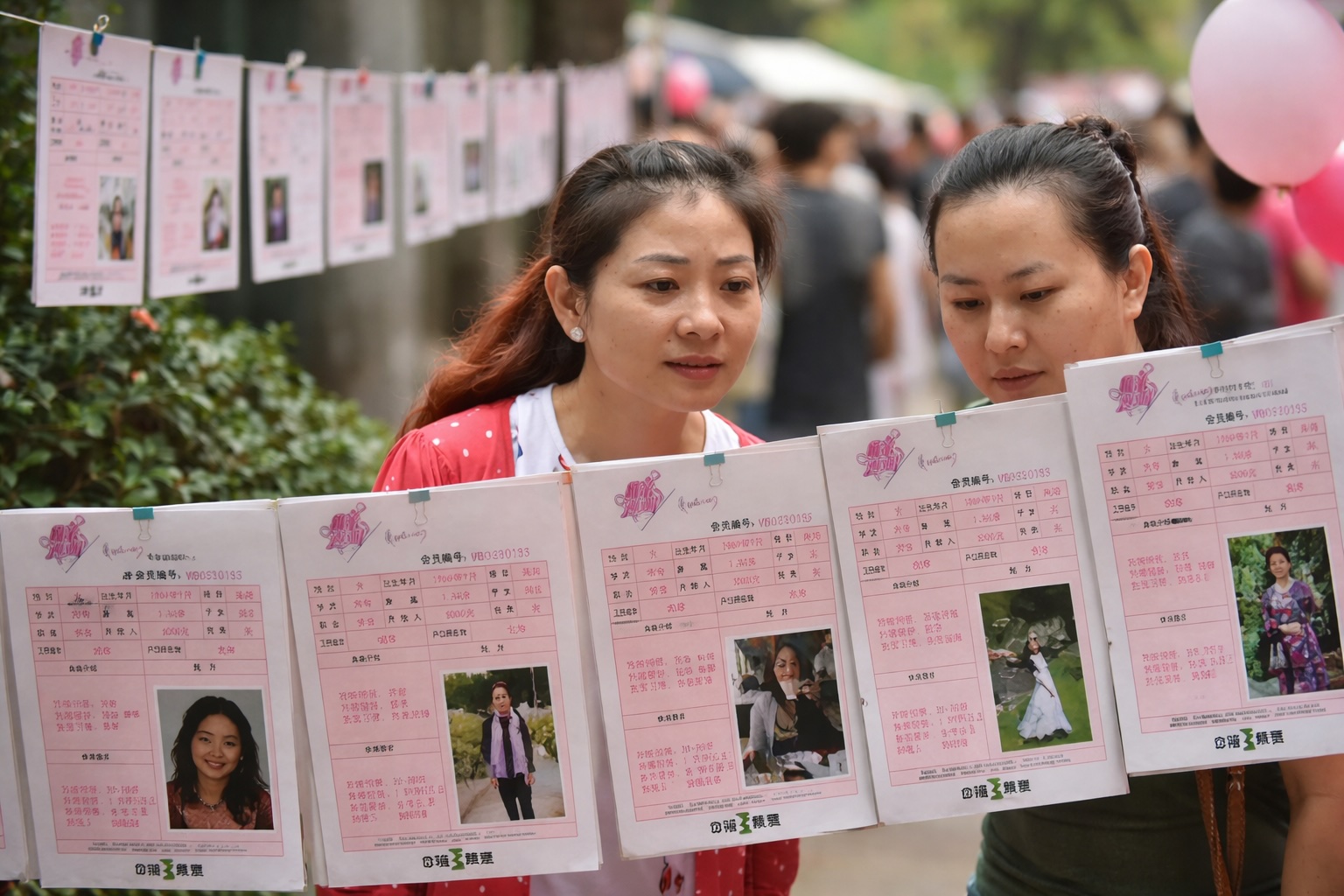
China’s Marriage Markets: The Park Where Parents Search for Love
April 4, 2026 6:11 pm Leave your thoughtsOn weekend afternoons in Chinese cities, public parks begin to change character almost imperceptibly. The morning crowds of tai chi practitioners give way to families strolling, elderly couples dancing to portable speakers, children chasing pigeons across wide plazas. And then, quietly, another gathering forms.
Umbrellas open even when there is no sun. Sheets of paper appear, clipped carefully to handles, laid across benches or held in plastic folders protected from the wind. People walk slowly between them, reading with focused attention.
Nothing is being sold.
Each page describes a person – but the person is not there.
Age, height, education, income, occupation, hometown registration, apartment ownership. Sometimes a zodiac sign. Occasionally a short line about personality. Often no photograph at all.
These are China’s marriage markets: places where parents come to find spouses for their adult children. The young people themselves are usually somewhere else entirely, living their lives, often unaware that negotiations on their romantic future are already underway.
A Dating Scene Without the Daters
The most famous gathering takes place every weekend in People’s Park, right in the center of Shanghai, though similar scenes unfold across Beijing, Guangzhou, Chengdu and many other cities.
Parents arrive carrying carefully prepared profiles – part résumé, part advertisement, part declaration of hope. Some documents are printed professionally, others handwritten with meticulous care. They compare information with strangers the way recruiters might scan candidates at a job fair.
Conversations begin cautiously, then quickly turn practical.
What university did your daughter attend?
Does your son own property?
Is the job stable?
How tall?
If the answers satisfy both sides, phone numbers are exchanged. Only later, sometimes reluctantly, do the children meet for a blind date arranged entirely without them.
To outside observers, it can feel strangely impersonal. Yet to those participating, the process is deeply human – even intimate – because it is rooted not in romance but in responsibility.
How Modern China Created an Ancient Practice
The marriage market looks traditional, but it is largely a modern invention.
For decades, many urban Chinese families raised a single child under the one-child policy. Parents concentrated their financial resources, ambitions, and emotional expectations into one future. Marriage therefore became more than a private milestone; it represented family continuity, social belonging, and security in old age.
At the same time, China’s rapid urbanization dismantled older matchmaking networks once provided by relatives, coworkers, and tightly knit neighborhoods. Millions moved into anonymous megacities where professional success expanded but social circles narrowed.
The park became a substitute for the vanished village. What appears old-fashioned is actually a creative response to modern isolation.
The Mathematics of Marriage
Reading the displayed profiles reveals a worldview in which marriage is approached almost analytically. Compatibility is measured through stability rather than chemistry.
For men, property ownership and steady income often dominate discussions, reflecting the intense pressures of China’s urban housing market. For women, education and age are frequently emphasized alongside descriptions such as “kind,” “gentle,” or “family-oriented.” Height requirements appear with remarkable consistency, and income brackets are discussed with a level of openness that might feel startling elsewhere.
Love rarely appears as a category because it is assumed to be unpredictable. Practical alignment comes first; emotional attachment, many parents believe, can grow later.
The logic may seem unromantic, yet historically it was common across much of the world. Modern romantic marriage – built on individual choice and emotional fulfillment – is a relatively recent cultural expectation.
Two Generations, Two Ideas of Happiness
The quiet tension surrounding these markets reflects a broader transformation within Chinese society.
Many younger urban Chinese delay marriage or question it altogether. Career ambitions, rising living costs, and changing ideas about independence have reshaped personal priorities. Dating apps and global cultural influences encourage relationships based on emotional compatibility rather than family arrangement.
Parents, however, interpret the same social changes through a different lens. Declining marriage rates and falling birth numbers generate genuine concern about loneliness, demographic imbalance, and the erosion of family traditions that once structured life.
The park therefore becomes more than a matchmaking venue. It is a space where two visions of adulthood intersect without directly confronting one another.
Parents negotiate stability. Children search for meaning. Between them lies an unresolved conversation about what a good life should look like.
The Real Purpose of the Gathering
Observers often ask whether these markets successfully produce marriages. Some matches do emerge, but effectiveness alone does not explain why parents return week after week.
Over time, the gatherings have evolved into social communities. Parents exchange stories about their children’s careers, frustrations, and hopes. They compare experiences, offer advice, and find comfort among others facing the same uncertainty.
In a society changing faster than any generation has previously experienced, the marriage market functions almost like a collective therapy session disguised as matchmaking. The conversations matter as much as the introductions.
Where Love Actually Lives
Seen from a distance, the scene invites easy judgment. It can appear controlling, transactional, even intrusive. Yet standing among the umbrellas reveals something quieter and more complicated.
Most parents understand that their children may reject the matches they arrange. Many openly admit this. They come anyway, not because they believe they can dictate love, but because doing nothing feels like abandoning responsibility.
Their presence in the park is an expression of care shaped by another era’s values – an attempt to help in a world that has changed faster than they have.
Love exists here, though not in the expected form. It is visible in the careful formatting of a résumé, in the hours spent waiting for conversation, in the hope that someone else’s child might become part of the family.
Love stands one generation behind the couple, quietly trying to guide events without fully controlling them.
An Unexpected Mirror
China’s marriage markets fascinate outsiders partly because they reverse familiar assumptions. Western societies tend to begin with romance and negotiate practical life afterward. Here, practicality opens the door and emotion is invited to follow.
Yet the deeper reason the scene feels so compelling may be uncomfortable: it reflects questions every modern society faces.
How do people meet partners in enormous cities?
How much should family influence personal choices?
Is love enough, or must stability come first?
Under the shade of umbrellas in a Shanghai park, these questions are not theoretical. They are discussed every weekend by parents who simply want their children to be safe, settled, and, eventually, happy.
The setting may look unusual, even surreal, but the motivation is universal.
In the end, the marriage market is less about arranging marriages than about navigating the uncertainty of modern life – a place where tradition and modernity sit on neighboring benches, patiently waiting to see which version of love will prevail.
Categorised in: Tales
This post was written by rado