Without a Parking Space, You Can’t Own a Car in Japan
April 9, 2026 7:26 pm Leave your thoughtsIn much of the world, buying a car is simple: choose a model, sign documents, and drive away. Where the vehicle will live afterward is rarely part of the transaction. Streets quietly become storage space, sidewalks narrow, and public land absorbs the consequences of private ownership.
Japan built its cities on a different assumption: a car may exist only if it already has a place to sleep.
A parking space comes before the car
Since the 1960s, Japanese drivers have been required to obtain a shako shomeisho – a “garage certificate” – before registering most private vehicles. The rule emerged during the country’s rapid economic expansion, when policymakers realized that dense cities with narrow streets could not survive uncontrolled car ownership.
To receive license plates, the future owner must prove access to an off-street parking space located near their residence, usually within two kilometers. The space can be a private garage, a rented spot, or a designated place in an apartment complex, but it must legally belong to the applicant and be reserved exclusively for that vehicle.
Only after the parking space exists can the car legally follow.
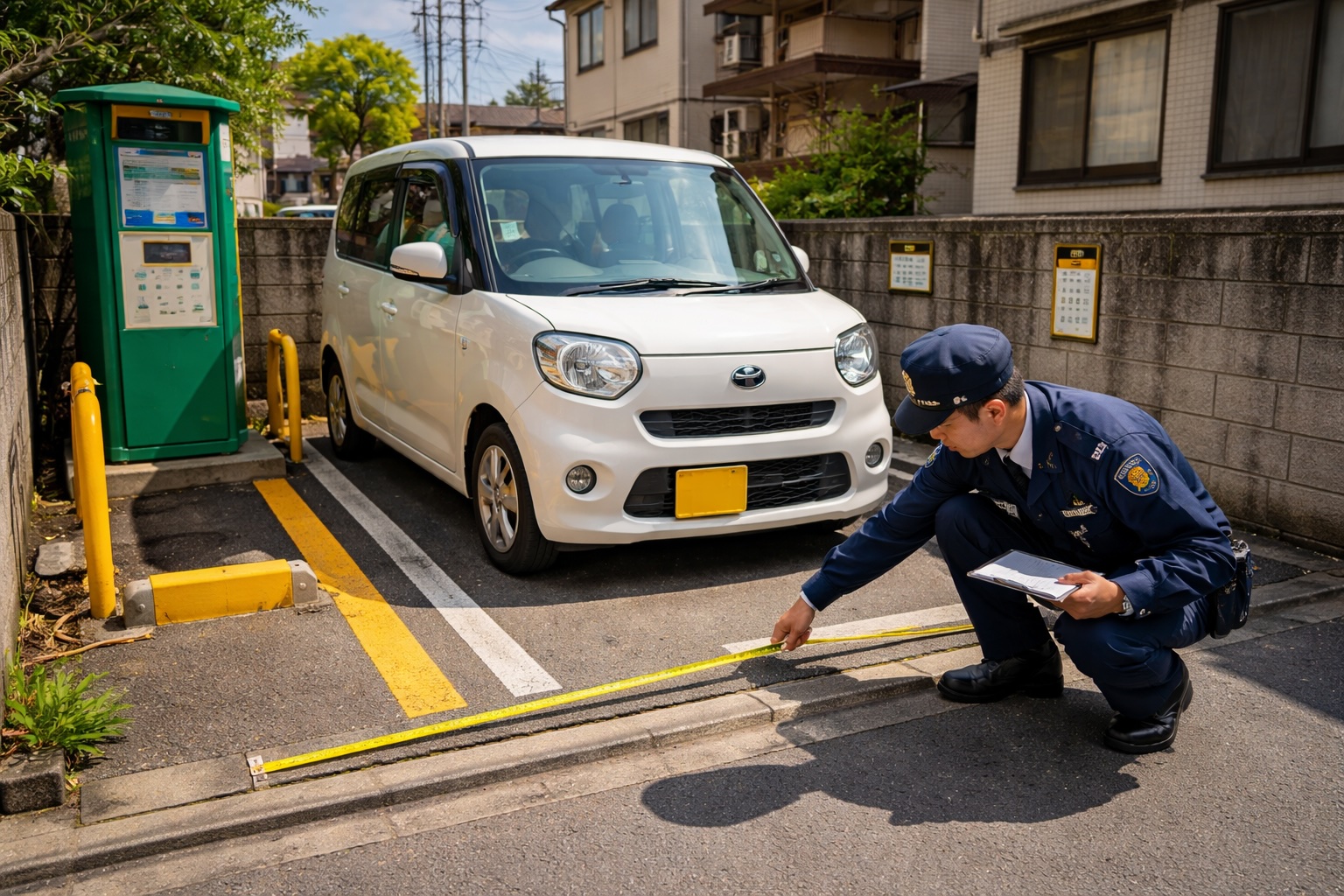
The verification is remarkably literal. Applicants submit diagrams and written consent from landlords if the space is rented, and local police may physically inspect the location. Officers confirm that the parking area is real, correctly sized, and usable without blocking traffic or neighboring property – sometimes arriving with measuring tape in hand. A street address alone is not enough; spatial reality must match paperwork.
Temporary street parking does not qualify. In Japan, public roads are for movement, not long-term storage.
A city shaped by invisible rules
The effects are subtle but transformative. Because every car must have a guaranteed home, Japanese neighborhoods avoid the slow takeover of sidewalks and green spaces common elsewhere. Residential streets remain navigable, deliveries move smoothly, and emergency access is rarely compromised.
Perhaps the most charming by-product is the landscape of tiny urban parking lots scattered throughout Japanese cities. Between houses, beside convenience stores, or squeezed into leftover slivers of land appear miniature parking areas holding three, five, or seven cars. Some are automated stack systems that lift vehicles vertically like mechanical shelves; others are simple painted rectangles occupying spaces too small for buildings but perfect for cars.
These micro parking lots reveal how thoroughly the rule reshaped urban economics. Even the smallest fragment of land gains purpose, not as an improvised solution to parking chaos but as planned infrastructure integrated into daily life.
The requirement also influences what people drive. Japan’s famous kei cars – ultra-compact vehicles designed for tight environments – thrive partly because they fit comfortably into limited certified spaces and keep ownership costs manageable. For many urban residents, however, the conclusion is simpler: they choose not to own a car at all.
Asia’s different answers to the same problem
Other Asian cities confronted mass motorization differently. Singapore restricts ownership through extremely expensive permits that cap the number of vehicles nationwide. Hong Kong relies on scarce land, high parking prices, and world-class public transport to discourage driving.
Japan’s solution stands apart because it regulates neither wealth nor traffic volume directly. Instead, it governs physical space. The system asks a basic question rarely posed elsewhere: if urban land is limited, why should private vehicles be allowed to occupy public space by default?
A quiet contrast
The difference becomes obvious when compared with many Eastern European cities. Large housing estates built in the socialist period were designed for far fewer cars than exist today. As ownership expanded, parking overflowed onto sidewalks, playground edges, and lawns. Enforcement often arrived late, inconsistently, or not at all.
The city adapts to the car rather than the car adapting to the city.
Japan reversed that relationship decades ago. Responsibility lies entirely with the owner: if you cannot store a vehicle without burdening shared space, ownership is simply not permitted.
The garage certificate rarely appears in tourist brochures, yet it helps explain why Japanese cities feel orderly without seeming restrictive. Order does not come from constant policing but from rules designed to prevent conflict before it begins.
In Japan, the decisive question is asked before the purchase: not “Can you afford a car?” but “Do you have somewhere for it to exist?”
Categorised in: Tales
This post was written by rado