Hong Kong: The Megacity That Is Actually a Wild Archipelago
April 3, 2026 2:09 pm Leave your thoughtsMost people arrive in Hong Kong expecting density. Skyscrapers, neon, crowded streets, constant movement – a city defined by vertical space and limited land. The surprise comes slowly, almost accidentally, when you look beyond the skyline and realize that the dense urban core occupies only a fraction of the territory. More than two-thirds of Hong Kong is protected natural landscape.
It is one of the most densely populated places on Earth, yet also one of the greenest urban environments in East Asia. Hong Kong is not simply a city surrounded by nature; it is a landscape of mountains, islands, forests, and coastlines in which the city happens to exist.
From Skyscrapers to Jungle in Fifteen Minutes
One of Hong Kong’s most unusual qualities is how abruptly environments change. You can leave a metro station surrounded by office towers and traffic lights and, within minutes, find yourself climbing a shaded trail through dense subtropical greenery, cicadas replacing car engines as the dominant sound.
The first time this happens, it feels slightly unreal – as if the city has ended too quickly.
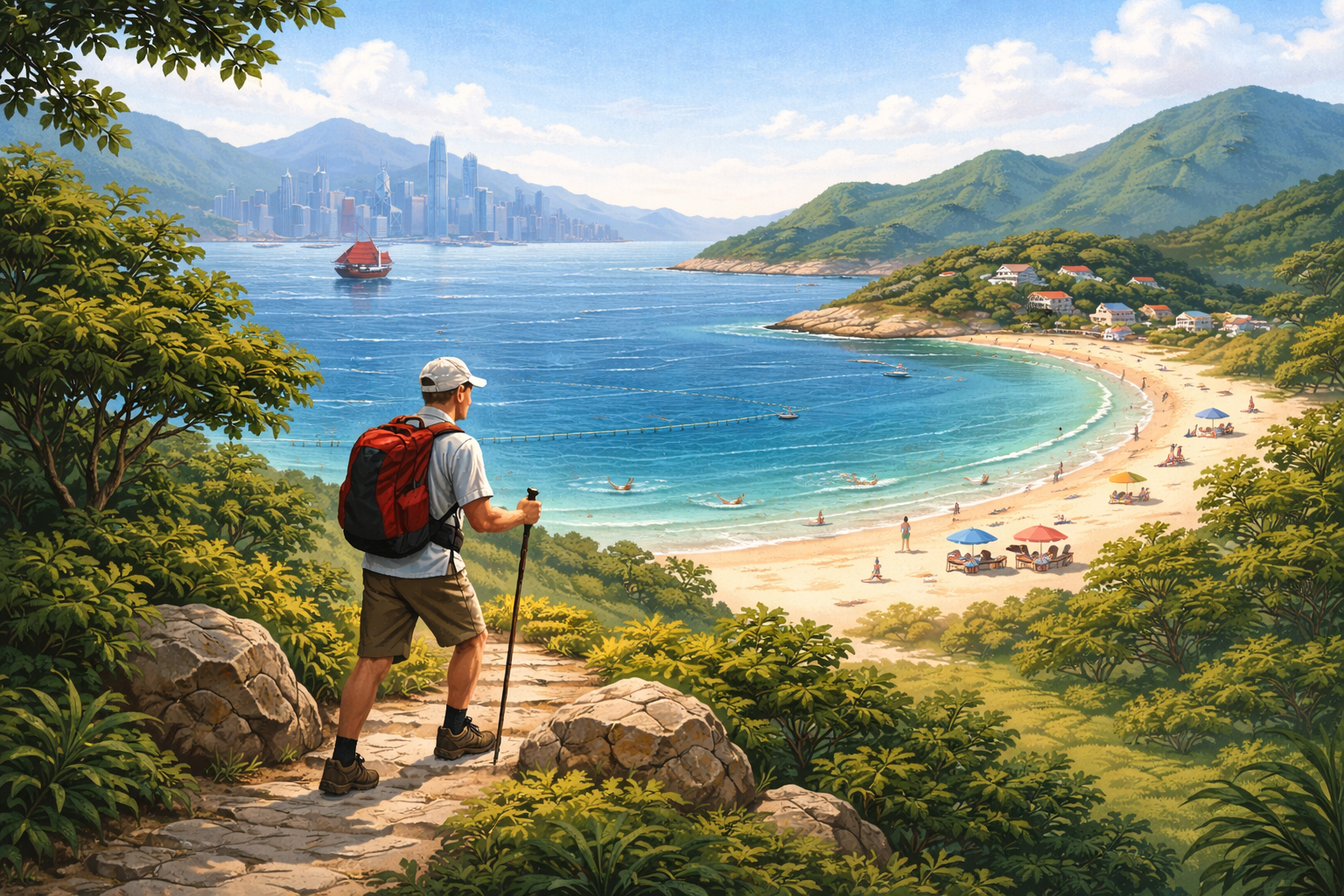
Hiking routes begin almost directly from residential neighborhoods. Trails such as Dragon’s Back or sections of the MacLehose Trail reveal sweeping views of the South China Sea: green ridgelines folding into quiet bays and scattered islands that feel closer to Southeast Asia than to a global financial capital.
The infrastructure itself is unexpectedly refined. Distance markers appear every few hundred meters, paths are carefully maintained, and emergency phones stand along remote ridges. At times, the mountains feel more systematically organized than urban sidewalks elsewhere. Nature here is not wilderness discovered by accident; it is public space treated with institutional seriousness.
A City That Goes Hiking Together
On Sunday mornings, central districts grow noticeably calmer because large parts of the population have headed uphill. Hiking in Hong Kong is not an outdoor niche but a shared civic habit practiced across generations.
It does not take long to notice a humbling pattern: steep climbs are often dominated by retirees moving steadily upward with remarkable speed, small backpacks on their shoulders. For many locals, hiking functions less as adventure and more as routine care for body and mind – something closer to a daily practice than a weekend challenge.
The reasons are practical. Apartments are compact, working hours long, and the need for space is tangible. The mountains provide air, distance, and psychological balance. With more than 500 kilometers of officially maintained trails, access to nature becomes part of everyday urban infrastructure rather than a luxury.
The result is unusual for a megacity: outdoor life does not oppose urban living but quietly completes it.
The Beaches No One Associates with Hong Kong
Even more surprising for newcomers is the coastline. Hong Kong has dozens of public beaches – wide arcs of sand with clean water, lifeguards, showers, and well-maintained facilities. Places like Repulse Bay, Shek O, or Tai Long Wan could easily belong to Australia or Southern Europe were it not for the dramatic island silhouettes offshore.
Look carefully and small details reveal the city’s relationship with nature. Many beaches are protected by discreet shark nets extending into the sea — barely visible from shore, yet reminding swimmers that this is still open water, not an artificial urban waterfront.
Despite their quality, the beaches often feel unexpectedly calm. While visitors cluster around Victoria Harbour and shopping districts, locals spend weekends swimming, grilling food at public barbecue areas, or simply watching the horizon. The atmosphere is relaxed and communal, less resort culture than shared urban breathing space.
The Archipelago Behind the Metropolis
Geographically, Hong Kong is an archipelago of more than 260 islands, many preserving an atmosphere entirely removed from the financial skyline. A short ferry ride leads to places like Lamma or Cheung Chau, where cars largely disappear, bicycles replace traffic, and seafood restaurants line quiet waterfront promenades.
The transition can feel disproportionate to the distance traveled. Within half an hour, the urgency of Central gives way to villages where life unfolds at a slower rhythm. Wildlife occasionally re-enters the picture as well: in certain country parks, macaque monkeys wander along the paths, sometimes attempting to steal unattended snacks – treated by locals with calm familiarity rather than surprise.
Hong Kong begins to reveal itself not as one city but as multiple overlapping environments connected by ferries, trails, and metro lines.
How Density Preserved Nature
The preservation of this landscape was the result of deliberate planning. During the British colonial period, large areas were designated as protected country parks, preventing suburban sprawl. Instead of expanding outward, the city grew upward.
The skyline, often seen as evidence of extreme urbanization, reflects a different logic. Concentrating millions of residents vertically allowed mountains, coastlines, and forests to remain largely untouched. Density, paradoxically, became a form of environmental protection.
The Real Surprise
What stays with many visitors is not a single landmark but a rhythm: morning coffee among glass towers, an afternoon hike through green hills, and sunset beside quiet water — all within the same city.
Hong Kong is often described as futuristic, yet its most distinctive quality may be something older and simpler. It has managed to remain both intensely urban and deeply connected to landscape at the same time.
Behind the skyline lies an archipelago – green, maritime, and unexpectedly peaceful – waiting just beyond the last high-rise.
This post was written by rado