Kami – The Invisible Presence Shaping Japan
April 1, 2026 12:35 pm Leave your thoughtsWhen Japanese people say kami, they are not talking about “gods” in the Western sense. The word resists direct translation. It may refer to a spirit, a presence, an essence, even the atmosphere of a place – something suspended between deity, nature, and emotion.
Kami lies at the heart of Shinto, Japan’s indigenous spiritual tradition, older than Buddhism, older than modern Japan itself, older even than the idea of a unified Japanese state. Yet the most intriguing aspect is that many Japanese people today consider themselves non-religious while continuing to live inside a cultural landscape profoundly shaped by kami.
Not Gods, but Presences
In Western traditions, God stands above the world – singular, omnipotent, separate from creation. Shinto imagines something different. Kami are not beyond nature; they emerge from it.
A mountain may be kami, just as a river, an ancient tree, a weathered stone, or even a location marked by memory or emotion can carry spiritual presence. Rather than existing in a distant heaven, kami inhabit the ordinary world.
Japan therefore does not revolve around one sacred landscape. Nearly every region recognizes its own spiritually meaningful places. Mount Fuji may be the most famous example, yet a modest hill overlooking a small town can hold equal reverence for the people who live beside it.
Kami do not require belief or conversion. Their presence is assumed rather than proclaimed.
Why Japanese People Bow Without “Believing”
Modern surveys often reveal that a large portion of Japanese society identifies as atheist or non-religious. Yet everyday behavior tells a more nuanced story.
- visit shrines at New Year,
- buy protective charms,
- bless new cars or businesses,
- pray before exams,
- hold weddings at Shinto shrines.
What appears contradictory from a Western perspective feels perfectly natural in Japan. Shinto asks for no declaration of faith, no doctrinal loyalty, no acceptance of absolute truths. Engagement with kami resembles etiquette more than religion – a quiet acknowledgment of one’s relationship with surroundings, community, and circumstance.
One does not believe in kami so much as live respectfully alongside them.
Purity Instead of Sin
Another profound difference lies in what Shinto considers the central human problem. Rather than sin or moral guilt, the concern is impurity – a disruption of harmony that may be physical, emotional, or spiritual.
The water basins at shrine entrances, where visitors wash their hands and rinse their mouths, symbolize restoration rather than repentance. The goal is not forgiveness but clarity.
This sensitivity to purity extends subtly into daily life:
- the remarkable cleanliness of Japanese cities,
- removing shoes indoors,
- students cleaning their own classrooms,
- an emphasis on order and care in workplaces.
Cleanliness becomes less a rule and more an atmosphere – a condition that allows harmony, and by extension the presence of kami, to emerge.
Kami in a Technological Society
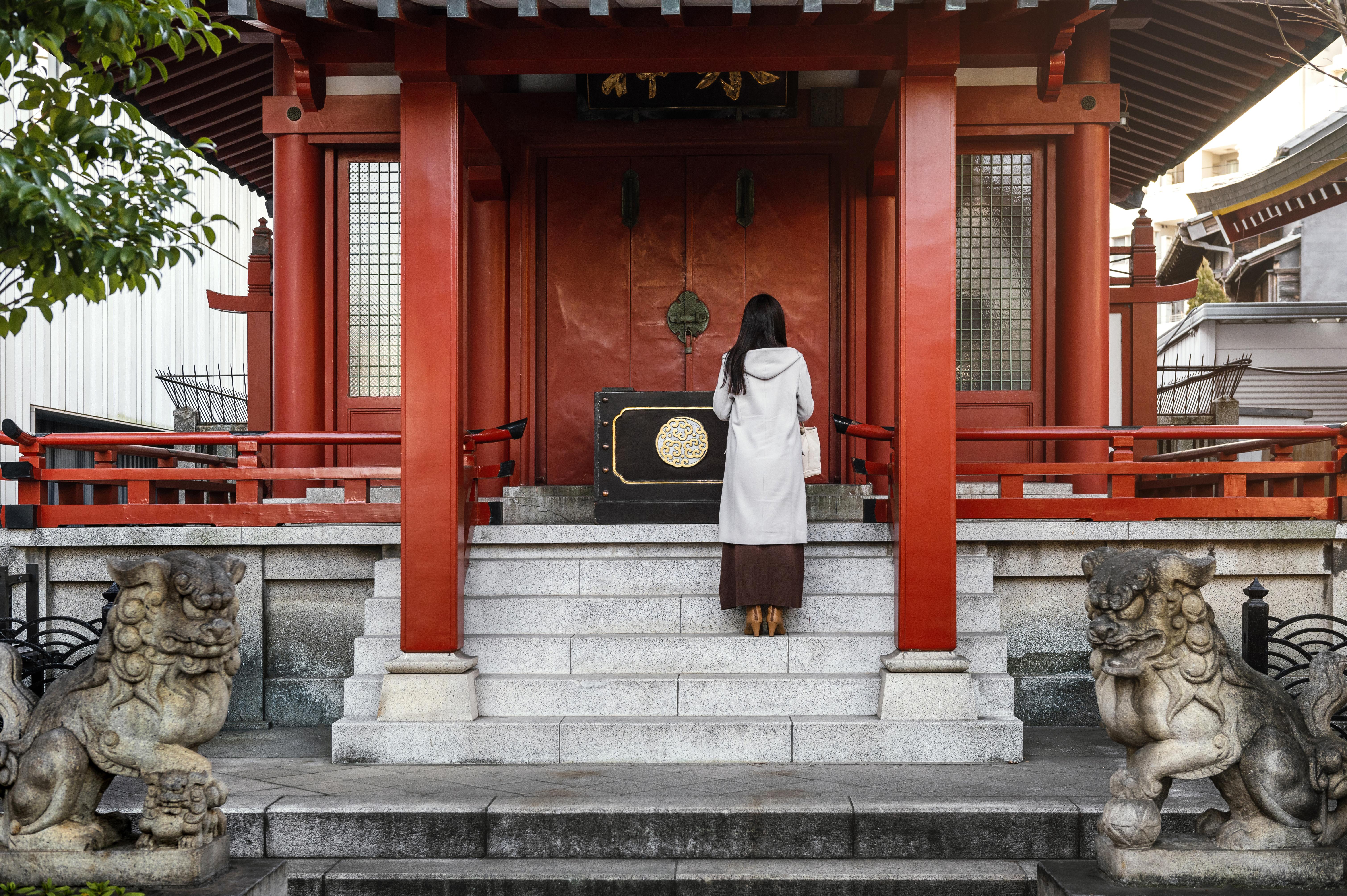
One of Japan’s most striking paradoxes is that rapid modernization never displaced older spiritual sensibilities. In Tokyo, small wooden shrines often stand quietly between steel towers and office buildings, reminders that development does not erase the spirit of place.
Construction projects frequently begin with Shinto rituals intended to calm the land before building begins. Even objects shaped by modern industry sometimes receive ritual closure:
- robots are ceremonially retired,
- well-used sewing needles are respectfully buried,
- broken dolls are burned in shrine ceremonies rather than thrown away.
These practices do not imply that objects literally possess souls. Instead, they acknowledge that human relationships – care, use, memory – can imbue things with a presence resembling kami.
When Nature Is Not a Resource
The idea that nature is inhabited by presence helps explain a quality visitors often struggle to articulate. Japan is intensely urban and technologically advanced, yet deeply attentive to seasonal change.
Cherry blossoms are not merely decorative scenery but fleeting encounters with spring itself. Autumn foliage, winter snow, the sound of summer cicadas, or a gentle rain each carry emotional resonance, almost personality.
Such sensitivity shapes poetry, cuisine, architecture, and everyday rhythms. Impermanence is not mourned as loss but appreciated as meaning. Nature is not a passive backdrop. It participates in human life.
Eight Million Kami
A traditional expression, yaoyorozu no kami, refers to “eight million kami,” though the number is symbolic rather than literal. It simply means countless – an infinite multiplicity of presences woven into the world.
Kami may be encountered in many ways:
- at a neighborhood shrine,
- in a family altar,
- in a forest path,
- in memory,
- or in a quiet moment of awareness.
When spiritual presence is understood as everywhere rather than exclusive, tolerance becomes almost inevitable. There is little need to insist on a single correct belief.
A Culture Without a Single Center
Perhaps the most far-reaching cultural consequence of kami is the absence of an absolute spiritual center.
No single god.
No single universal truth.
No single sacred place.
Instead, Japan becomes a constellation of small sacred spaces, each meaningful within its own context. This helps explain social tendencies toward harmony, situational awareness, and compromise – preferences for balance rather than ideological certainty.
The Hidden Logic of Japan
To outsiders, Japan often appears full of contradictions:
- technologically advanced yet traditional,
- secular yet ritualistic,
- rational yet quietly spiritual.
Kami offer a gentle explanation.
Kami offer a subtle explanation – not as a formal religion, but as a way of sensing the world. In this worldview, nothing is entirely lifeless and every place deserves a measure of respect.
Perhaps that is why Japanese people rarely ask whether something has a soul. They simply behave as if it might.
Categorised in: Tales
This post was written by rado