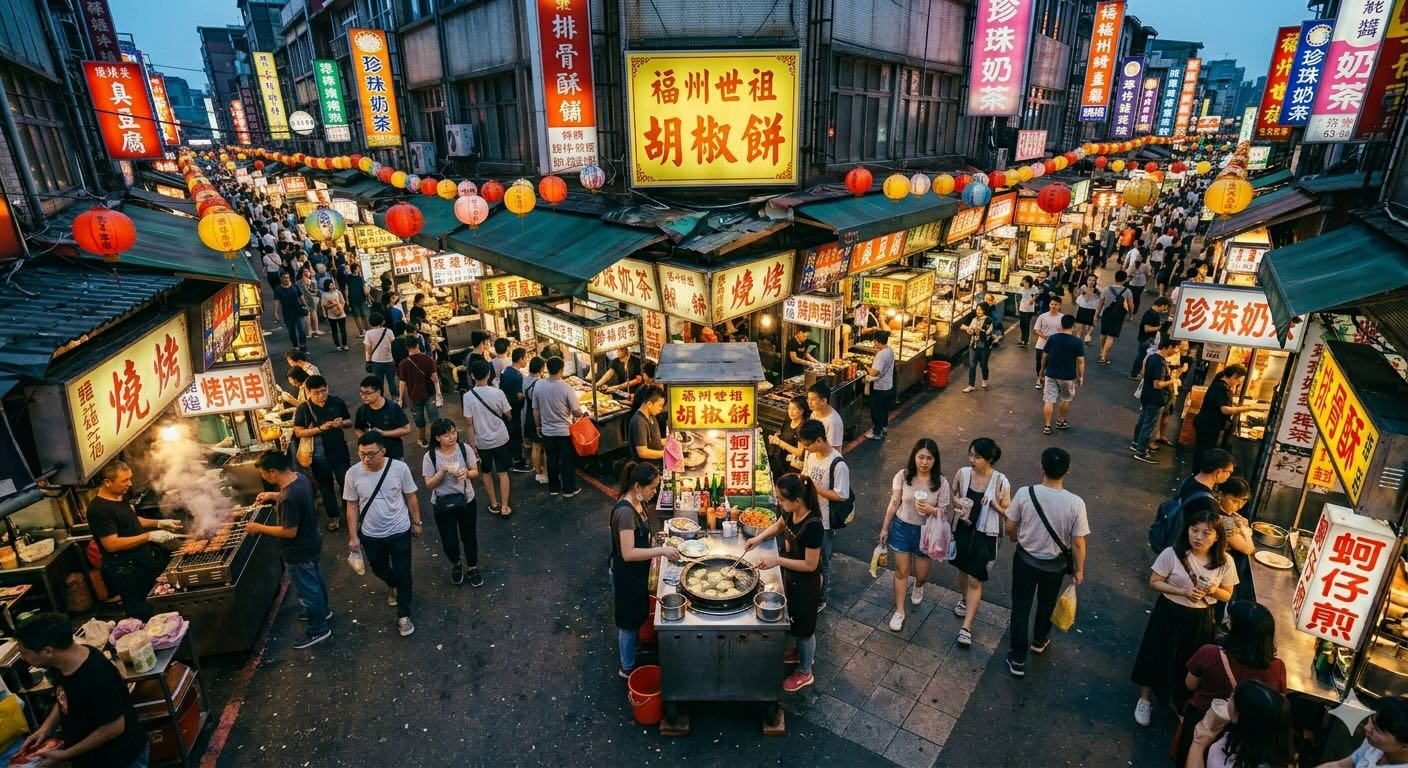
Taiwan’s Night Markets, Where City Life Begins After Sunset
April 2, 2026 12:29 pm Leave your thoughtsIn many parts of Asia, active life does not end in the evening – it simply changes rhythm. Few places embody this better than Taiwan’s night markets. They are not tourist attractions or occasional neighborhood festivals. They are everyday life on the island – an evening kitchen, a social network, an amusement park, and a public square condensed into a few lively streets.
If Taiwan could be understood through a single experience, it would almost certainly be the night market.
The City After Work
After 6 p.m., Taiwan begins its second day. Office workers step off the metro, students in uniforms blend into crowds of employees, and families go out “just for a quick bite” that often turns into hours.
Night markets emerged after World War II, when street vendors began gathering around temples and transport hubs. Temporary stalls gradually evolved into semi-permanent institutions. Today almost every neighborhood has its own market – some operating continuously for decades.
The most famous is Shilin Night Market in Taipei – a maze of streets, lights, and aromas where one can spend an entire evening without repeating a dish.
But the reputation extends beyond the capital. Raohe Street Night Market offers a more compact experience with an almost theatrical entrance – a temple, red lanterns, and a constant flow of people. In the southern city of Kaohsiung, Liuhe Night Market transforms each evening into a culinary showcase of southern Taiwan.
Eating as a Social Ritual
In Europe, dinner means a table and an order. In Taiwan, it means movement. People do not “go out for dinner.” They wander. A snack here, something sweet next, a drink afterward, then another bite “just to try.” Groups rarely sit down immediately – eating becomes a shared act of tasting and exploring.
There is also a practical reason: Taiwanese apartments are often small, and daily cooking is not always convenient. The night market becomes the neighborhood’s extended kitchen.
The Smell of Taiwan
The first thing visitors notice is not the view but the scent – sweet, fried, fermented, smoky.
Several classics almost always appear:
- giant fried chicken cutlets larger than the customer’s face
- oyster omelets – eggs, starch, and seafood combined in a strangely addictive way
- bubble tea, which began as a local drink and became a global phenomenon
- grilled squid prepared right in front of you
- and the legendary stinky tofu – fermented tofu with an intense aroma that first repels, then becomes unforgettable
Many of these foods rarely exist in quite the same form inside restaurants. They belong to the street.
The Market as an Amusement Space
Night markets are not only about food. Between the stalls appear small games – balloon shooting, ring toss, arcade machines, claw-grab prize machines, retro video games. Children play, but adults join just as eagerly.
There is no clear boundary between food, entertainment, and shopping. You can buy socks, a phone case, a plush toy, a pet, a quick massage, or even a haircut – all within a single street.
The Invisible Organization
What looks like chaos is actually carefully ordered. Stalls are often passed down through families. Many vendors spend decades perfecting a single dish. Recipes improve daily through the simplest feedback system imaginable – if something is not good, customers simply move on.
The result is surprisingly high quality without the need for formal restaurants. The night market is free market economics in its most literal form.
Courtesy Within the Crowd
Despite the enormous crowds, the atmosphere rarely feels aggressive. Taiwanese habits of shared space function even at densities that would seem impossible elsewhere. People move slowly but smoothly. Lines form naturally. There is little competition for space.
One unwritten rule applies everywhere: if there is a queue, the food is probably worth waiting for.
Why Night Markets Survive
Many Asian cities have moved street food into sterile indoor food halls. Taiwan has done the opposite – the modern city has preserved its street soul.
Night markets simultaneously serve several roles:
- affordable food for all social groups
- an accessible path to small business ownership
- a meeting place across generations
- a safe evening urban environment
They are economy, culture, and social infrastructure at the same time.
The Taiwan That Doesn’t Fit Into Brochures
Museums tell a country’s history. Mountains show its nature. Night markets reveal its people.
Here Taiwan feels most natural – noisy, curious, slightly chaotic, and unexpectedly warm.
Perhaps that is why many visitors discover their strongest memory of the island is not a temple, a view, or a landmark, but an ordinary evening spent walking without a plan, holding several different snacks at once, and realizing that the city around them is completely, vividly awake.
This post was written by rado